Basic e-Filing Questions
Answer
Electronic filing or e-filing enables filers and courts to efficiently process documents and fees online. E-filing manages the flow of information among filers, clerks, court personnel, and judges:
Answer
Yes. The Tyler e-filing system adheres to state and federal security regulations and meets Payment Card Industry Security Standards to protect filer and transaction information.
Answer
The filers identified below must electronically file documents in Idaho state courts:
There are exceptions, which are found in Rule 5 of the Idaho Rules for Electronic Filing and Service
Self-represented parties who are individuals and not attorneys may choose to electronically file documents but are not required to do so. Those who choose not to use electronic filing, and who require paper / mail service from the court, must identify the physical address for service in the certificate of service and pay designated mail service fees to the court clerk at the time of filing. With the exception of an initial electronic filing of a petition for a civil protection order made by a victim advocate on behalf of a self-represented party through File and Serve, a self-represented party who chooses to electronically file and serve documents through the electronic filing system must continue to do so for the life of the case unless a court has granted a motion to withdraw from electronic filing and service. Once a self-represented party withdraws from electronic filing and service, he or she may not return to this practice for the life of the case.
Self-represented individuals who use Guide and File to file Court Assistance Office forms are not required to submit later filings through the electronic filing system. Similarly, an initial case filing of a petition for a civil protection order made by a victim advocate on behalf of a self-represented party through Guide and File does not require the party to submit later filings through the electronic filing system. Businesses filing in small claims actions may use Guide and File to file Court Assistance Office forms if available. Other documents must be filed through File and Serve.
Answer
Most, but not all, documents are subject to mandatory e-filing. Documents that must be filed conventionally (paper form at court filing counter) include:
Answer
Answer
Self-represented parties who are individuals and not attorneys may choose to electronically file documents but are not required to do so. Those who choose not to use electronic filing, and who require paper / mail service from the court, must identify the physical address for service in the certificate of service and pay designated mail service fees to the court clerk at the time of filing. With the exception of an initial electronic filing of a petition for a civil protection order made by a victim advocate on behalf of a self-represented party through File and Serve, a self-represented party who chooses to electronically file and serve documents through the electronic filing system must continue to do so for the life of the case unless a court has granted a motion to withdraw from electronic filing and service. Once a self-represented party withdraws from electronic filing and service, he or she may not return to this practice for the life of the case.
Self-represented individuals who use Guide and File to file Court Assistance Office forms are not required to submit later filings through the electronic filing system. Similarly, an initial case filing of a petition for a civil protection order made by a victim advocate on behalf of a self-represented party through Guide and File does not require the party to submit later filings through the electronic filing system. Businesses filing in small claims actions may use Guide and File to file Court Assistance Office forms if available. Other documents must be filed through File and Serve.
Answer
Idaho courthouses have computers that provide access to e-filing for self-represented litigants. Please note that if you are a self-represented litigant and you choose to use e-filing and e-service, you will be responsible for reviewing your emails on a regular basis for service of documents from other parties and notices from the court. Not checking your email will not be a reasonable excuse for failing to comply with a court order or timely responses to legal pleadings.
Understanding Fees
Answer
The filer is responsible for paying standard court filing fees. Tyler Technologies, the e-filing vendor, collects a $5.00 fee to use electronic filing. This fee is not added to criminal cases or service-only envelopes. Certain users and case types are exempt but must use a waiver account. Click here for more information. There is also a convenience fee that is assessed to cover the credit card processing fees.
Answer
People using electronic filing may file online using credit or debit cards. Cash payments for making your filings can still be made at the court.
Answer
The Optional Services drop down serves two purposes:
Examples of optional services include paying an initial appearance fee, paying for court-mandated classes, or paying for court service by registered mail. After you have loaded your first document and clicked “Save Changes,” the “Optional Services” button will appear.
Answer
The dropdown contains the various services available and the associated fees to attach to that particular document. If you have multiple documents to load in a single e-filing session (also referred to as loading them in one envelope), be careful to link the particular service to the particular document. For example, if you have four documents to load but only one requires a certified copy, be careful to select the service of certified copy for that particular loaded document. This may not apply to the fee to have the court mail and serve court-signed pleadings. See below for more details.
Answer
If you are making your initial appearance by Answer or Notice of Appearance, you must select the Optional Service “Initial Appearance” to pay the required filing fee. Failure to do so will result in the rejection of your pleading by the court with a request that you resubmit with payment.
Answer
One advantage of the electronic case management system is the court will serve any signed orders or notice submitted by the parties via email to those attorneys or parties who use electronic filing. But what about cases that involve a self-represented litigant or a party who simply never appeared in the lawsuit, but per the rules requires service? This fee covers mail service by the court for parties who do not participate in electronic filing.
As described above, select “Optional Services” after you have loaded your document(s). Then select the appropriate mailing fee based upon the number of pages your pleading is.
Mailing Fees - Next, select how many mailings you need sent by the court. This will most likely be determined by how many different parties need to be served by mail.
Thinking of this in terms of paper simplifies the process. One example: You are filing in a case with three other parties. Two are accepting service through electronic filing and one is a self-represented party who has elected to opt out of electronic filing and service.
You are filing four documents: a motion, proposed notice of hearing (2 pages), affidavit of fact witness, and proposed order (3 pages). This means there are two documents that need to be forwarded via mail to the self-represented party after they are signed by the court.
Typically where the filer has one case with one envelope to be served on one party, you only need to select one mailing fee for the mailing. In this case, however, the notice of hearing would be served before the hearing and the proposed order (if the motion is granted) would be signed after the hearing.
Therefore the filer should either A) select “Mailing Fee (1-4) pages” and select the Quantity as two as the court is making two separate mailings; or B) select one “Mailing Fee (1-4) pages” when you load the Proposed Notice and another ”Mailing Fee (1-4) pages” when you load the Proposed Order. Either way, the filer should use the “Filing Comments” field in “Filings” to provide instruction to the clerk regarding what services you have purchased and how specifically you need the clerk to serve the court-executed document.
Answer
The e-filing software asks that you select from a dropdown the “Party Responsible for Fees.” Select the party for whom the documents are being filed.
Some self-represented litigants have questioned whether they should select the opposing party based on the belief that they will prevail in the end and a judge will order the opposing party to pay their court filing fees. While this may or may not occur, this filing field is a feature for attorneys to record, for internal purposes, who is responsible for reimbursing the filing fee. As such, the correct selection is the party for whom the documents are being filed.
NOTE: Some case types have the party names hidden. In this case the “party responsible” will not be identifiable. In such a case, select any party and the clerk will make adjustments if necessary upon their review.
Filer Information
Answer
Yes. There are now two ways to comply with this requirement.
Answer
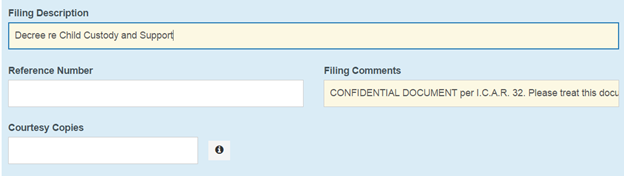
Per I.C.A.R. 32(g)(20) the records in cases involving child custody, child support, and paternity are exempt from public disclosure. However, the rule also states that no redacted copy of any order, decree or judgment must be prepared until there is a specific request for the document, in which case the document should be redacted in the manner specified in Idaho Rule of Civil Procedure 3(c)(1) (a)-(d).
To comply with the language above the attorney or self-represented litigant should electronically file and serve the proposed orders, decrees, or judgment in unredacted form BUT must identify in the e-filing software that the document is “CONFIDENTIAL.” This will alert the clerk to properly exempt said document. In the event that a copy is requested by the public the court will then make a redacted copy of the record available for inspection. The copy will also exclude those portions of the record that allege abuse, abandonment or neglect of a child, or which the court determines would inflict undue embarrassment to or put at risk a person referenced in the record who was a child at the time of the filing of the record, or which are exempt from disclosure under the other provisions of Supreme Court rules.
Answer
Yes. Please continue to include a certificate of service. Of course, the certificate will now indicate that you served your document via the File and Serve system to the email that was identified as the party’s service contact.
NOTE: Filers who submit proposed pleadings for the court’s review, signature, and service (such as an order, notice of hearing, judgement, decree, etc.) must include a certificate of service that identifies the email address necessary for the court to complete electronic service of those parties who have electronically appeared in the action.
Answer
First, review Idaho Bar Commission Rule 227 to make sure that you have complied with the rule regarding appearing in the State of Idaho. The rule is clear that an Idaho attorney must remain on the case and be someone “with whom the court and opposing counsel may readily communicate regarding the conduct of the case.” Further, the Idaho attorney must be present on all matters before the court (unless excused by the judge). As such, in the context of electronic filing and serving, there are two options for the out of state attorney to electronically file in the Idaho court:
It would not be appropriate or necessary to register an out-of-state firm as an Idaho law firm. If you anticipate that you are an out of state attorney that will want to file from out of state yourself, option No. 2 would allow you to do that. You simply contact the registered Idaho law firm administrator and ask them to send you an invitation to be a "Firm User."
Answer
Generally you may only designate a service contact for the party you represent, not for other parties. If the party you intend to serve is lacking a service contact, contact that party's attorney to request that they load a service contact as required by Supreme Court's Electronic Filing Rule. The Rule also permits a user to serve the document conventionally if the person being served has failed to designate a service contact.
An exception, however, exists for when the other party is an attorney licensed with the Idaho State Bar or a county prosecutor or public defender. The system will allow you to perform a name search of the available "Public Service Contacts," find the attorney or county prosecutor or public defender office and designate them when they have failed to do so on their own.
CLICK HERE for complete step by step instructions.
Answer
The first question is, what is "Confidential"? "Confidential" in reference to a document or information means the document or information will not be accessible to the public because it is exempt from disclosure or sealed by court order pursuant to Idaho Court Administrative Rule 32 or information barred from disclosure to the public under federal or state law. Review Idaho Court Administrative Rule 32 for a better understanding of the difference between a document that is "exempt from disclosure" without order and the process for seeking an order from the court to seal or redact a document.
Pursuant to the Idaho Supreme Court's Electronic File and Serve rule, if you need to file a motion to seal a document by court order you must file that motion (and the document that is the subject of the motion) conventionally. In other words, you need to file the document in paper form to the court clerk.
If you are filing a document that is exempt from disclosure or sealed per a preexisting court order, then you MUST identify the document as "confidential" in the Filing Comments. The court will verify that designation and after review may modify the designation of any document incorrectly identified as “confidential.” Once the designation as “confidential” is confirmed, the document will not be accessible to the public, but will be accessible to court staff and, where applicable, to certain governmental entities as authorized by law, court rule, or court order.